
As winter settles in and neighborhoods begin to glow with strings of twinkling bulbs, many people report a quiet emotional shift—a warmth that rises not just from holiday cheer but from something deeper. It’s not merely the sight of Christmas lights that moves them, but a specific kind: the old-school, incandescent C7 or C9 bulbs with their warm amber flicker, often unevenly spaced on rooftops and trees. These lights don’t just illuminate homes—they illuminate memories. The phenomenon is widespread and deeply personal: seeing these particular lights can summon images of childhood living rooms, family gatherings, long drives through decorated streets, or the scent of pine and cinnamon in the air. But what exactly causes this powerful sense of nostalgia? And why do some light styles evoke it more than others?
The answer lies at the intersection of psychology, sensory perception, cultural tradition, and even neuroscience. Nostalgia is not random; it’s cued by specific stimuli, and few are as potent during the holiday season as the visual language of Christmas lighting. Understanding this connection offers insight into how our brains preserve emotional history—and why something as simple as a string of lights can momentarily transport us decades into the past.
The Psychology of Nostalgia and Sensory Triggers
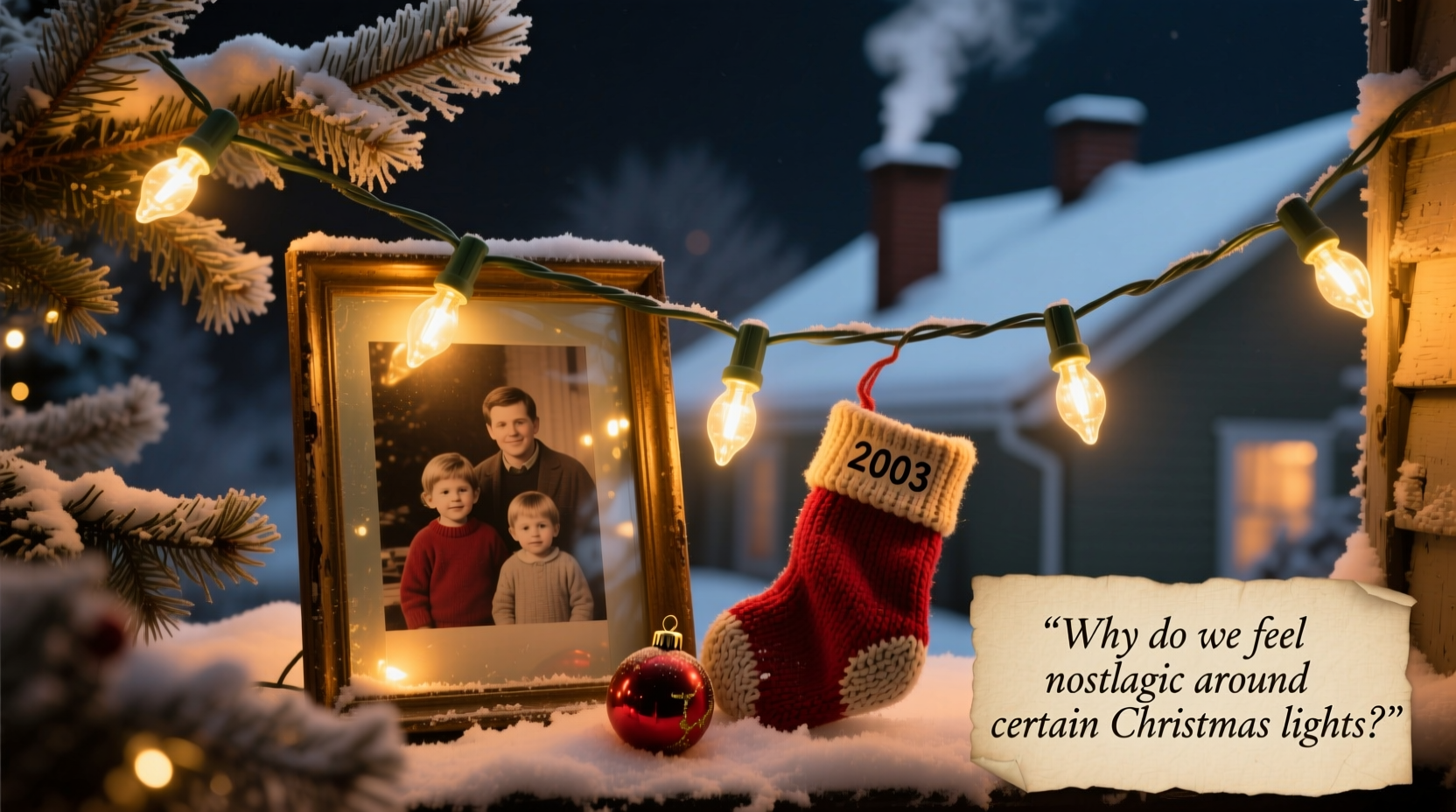
Nostalgia is a bittersweet longing for moments gone by, typically associated with positive emotions despite the inherent loss implied in time passing. Psychologists define it not as escapism, but as a self-relevant, emotionally rich mental process that strengthens identity, social connectedness, and psychological resilience. When triggered, nostalgia often involves vivid recollections tied to specific senses—especially smell, sound, and sight.
Christmas lights serve as powerful visual anchors because they are both rare and ritualistic. Unlike everyday lighting, they appear only once a year during a period already saturated with emotion and meaning. This temporal scarcity increases their symbolic weight. When people see traditional Christmas lights—particularly those resembling the ones used in their youth—the brain activates neural networks linked to autobiographical memory, especially in the hippocampus and prefrontal cortex.
Dr. Krystine Batcho, a leading researcher on nostalgia, explains:
“Nostalgia is most easily evoked by familiar sensory cues that were present during formative experiences. A particular song, a scent, or even the quality of light can become a portal to the past because they were encoded alongside emotionally significant events.”
In this context, vintage-style Christmas lights—those large, soft-glowing bulbs in warm white, red, green, blue, and yellow—are more likely to trigger nostalgia than modern LED alternatives. Why? Because they closely resemble the lights many adults remember from childhood Christmases before LEDs became standard in the 2000s. The imperfection—the slight flicker, the visible wire, the way snow reflects off the glass bulbs—adds authenticity that the brain interprets as “real” or “original,” enhancing the emotional resonance.
Why Traditional Lights Evoke Stronger Memories
Not all Christmas lights are created equal when it comes to emotional impact. A 2019 study published in the journal *Emotion* found that participants reported significantly higher levels of nostalgia when viewing photographs of homes decorated with older-style incandescent lights versus sleek, uniform LED strips. The key differentiators weren't brightness or color—but texture, warmth, and perceived authenticity.
Traditional C7 and C9 bulbs emit a warmer color temperature (around 2200–2700 Kelvin), closely mimicking candlelight or firelight—two primal sources of comfort and gathering. In contrast, many modern LED sets emit a cooler, bluer light (often 3000K or higher) that, while energy-efficient, lacks the same emotional warmth. The brain associates warmer light with safety, intimacy, and celebration—conditions prevalent during cherished holiday moments.
Beyond color, there's also rhythm. Older lights, especially those on series-wired strands, often have a subtle pulse or shimmer due to alternating current fluctuations. This micro-flicker—unintentional, yet characteristic—is absent in steady-burning LEDs. That tiny variation may seem negligible, but it contributes to the “lived-in” aesthetic that the brain recognizes as genuine and historically consistent.
Cultural Memory and Generational Lighting Traditions
The design of Christmas lights has evolved dramatically since their debut in 1882, when Edward H. Johnson hand-wired 80 red, white, and blue bulbs to decorate a tree in New York City. Over the decades, mass production made lights more accessible, and by the 1950s and 60s, strings of colorful C7 bulbs adorned porches across America. These became emblematic of mid-century holiday culture—featured in films, television specials, and advertising.
For Baby Boomers and Generation X, these lights are not just decorations; they are artifacts of cultural memory. Seeing them rekindles associations with classic holiday programming like *A Charlie Brown Christmas*, where the final scene features a single illuminated tree with bare branches and simple colored bulbs—an image now iconic for its emotional honesty and understated beauty.
Millennials and younger generations may experience similar nostalgia, though often secondhand. They might associate vintage-style lights with parents’ traditions, retro-themed holiday markets, or curated social media aesthetics celebrating “old-fashioned” Christmases. In this way, nostalgia becomes layered—personal memory blends with cultural storytelling, reinforcing the emotional power of certain lighting styles.
| Light Type | Era of Popularity | Common Emotional Associations | Nostalgia Potential |
|---|---|---|---|
| Incandescent C7/C9 Bulbs | 1950s–1990s | Family, tradition, warmth, simplicity | ★★★★★ |
| Mini Incandescent Lights | 1970s–2000s | Cheerfulness, abundance, festivity | ★★★★☆ |
| LED Rope Lights | 2000s–present | Modern, clean, efficient | ★★☆☆☆ |
| Flame-Tip Vintage LEDs | 2010s–present | Retro charm, elegance, nostalgia-by-design | ★★★★☆ |
How Environment and Ritual Reinforce Emotional Recall
The setting in which we encounter Christmas lights plays a crucial role in shaping their emotional impact. Driving through a neighborhood known for elaborate displays—especially one visited annually as a child—can amplify nostalgia through environmental consistency. Familiarity breeds emotional safety, and when combined with seasonal rituals (hot cocoa, caroling, gift shopping), the effect compounds.
A real-world example illustrates this well: Sarah M., a 42-year-old teacher from Ohio, describes her annual pilgrimage to the \"Candy Cane Lane\" in her hometown. “Every December, my dad would load us into the station wagon, turn on the heater, and drive slowly down that street. I can still hear the hum of the engine and the crinkle of my mittens. Now, when I take my own kids there, I get choked up—not just because it’s pretty, but because the lights are exactly the same: big round bulbs, slightly crooked on the eaves. It’s like stepping into a memory.”
This kind of multi-sensory ritual embedding makes the visual cue of the lights far more potent. The brain doesn’t store memories in isolation—it links sights, sounds, smells, and emotions together. So when the eyes register those familiar bulbs, the mind unconsciously retrieves the entire experiential package: the cold air, the music playing, the feeling of being small and safe in a world lit by wonder.
Creating Nostalgic Experiences: A Step-by-Step Guide
Whether you're decorating your home, planning a community event, or simply seeking to reconnect with your own past, you can intentionally use lighting to foster nostalgia. Here’s how:
- Choose warm-toned bulbs (2200K–2700K): Avoid cool white LEDs. Opt for incandescent or high-quality warm-white LEDs that mimic the glow of vintage sets.
- Use larger, spaced-out bulbs: C7 or C9 bulbs placed 6–12 inches apart create the classic “retro” look that resonates with mid-century memories.
- Incorporate visible wiring and sockets: Exposed lines and plastic bases signal authenticity. Concealed wires, common in modern kits, reduce the nostalgic effect.
- Add subtle movement: Consider lights with a gentle twinkle or ripple effect. Avoid rapid flashing or digital animations, which feel commercial rather than personal.
- Pair with complementary sensory elements: Combine lighting with scents (cinnamon, pine), sounds (vinyl records of classic carols), and activities (baking cookies, wrapping gifts) to deepen the immersive experience.
FAQ
Can LED lights evoke nostalgia too?
Yes—especially if they’re designed to mimic vintage styles. Flame-tip LEDs, warm color temperatures, and bulb shapes resembling candles or old incandescents can trigger similar emotional responses. The key is authenticity of appearance, not technology.
Why don’t all Christmas lights make me feel nostalgic?
Nostalgia depends on personal history. If you grew up with mini-lights or modern displays, those may be your emotional triggers. However, research suggests that larger, warmer, and less uniform lights tend to have broader nostalgic appeal due to their association with earlier eras and analog aesthetics.
Is nostalgia around Christmas lights a universal experience?
While not universal, it is widespread in cultures where Christmas involves outdoor lighting traditions. The emotional mechanism—sensory-triggered autobiographical recall—is common across populations, but the specific cues (like bulb type) depend on individual and cultural exposure.
Checklist: Designing a Nostalgic Lighting Display
- ☐ Use warm white or multi-color bulbs with soft glow
- ☐ Select C7 or C9 size bulbs for authentic vintage look
- ☐ Avoid excessive brightness or digital effects
- ☐ Mix in heirloom decorations or family ornaments
- ☐ Play classic holiday music during viewing times
- ☐ Invite shared rituals (e.g., hot chocolate nights, photo walks)
- ☐ Maintain consistency year after year to build tradition
“Nostalgia isn’t about the past—it’s about who we were when we experienced it. A string of lights doesn’t just shine on a house; it shines on the person we once were.” — Dr. Rebecca Turner, Cognitive Psychologist
Conclusion
The glow of certain Christmas lights does more than brighten winter nights—it reawakens the heart. What appears as mere decoration is, in fact, a complex emotional catalyst rooted in memory, biology, and shared culture. The reason people feel nostalgic around traditional Christmas lights is not sentimental exaggeration, but neurological truth: these lights resemble the ones present during formative, emotionally rich moments, and the brain remembers.
By understanding this connection, we can be more intentional—not only in how we decorate, but in how we preserve and pass on meaning. Whether you’re hanging lights on your eaves or driving your children down a glowing street, you’re not just creating a scene. You’re building future memories, layering sensory cues that may one day spark someone else’s quiet moment of return.




 浙公网安备
33010002000092号
浙公网安备
33010002000092号 浙B2-20120091-4
Comments
No comments yet. Why don't you start the discussion?