
Every December, social media feeds fill with cozy, curated shots of perfectly decorated Christmas trees—often featuring a neatly wrapped base draped in white linen, burlap, or even vintage quilt scraps. At first glance, it looks purely decorative. But behind that tidy fold lies a convergence of practical necessity, safety awareness, tradition, and clever household improvisation. Wrapping the tree stand in a sheet isn’t a viral fad—it’s a time-tested, multi-functional solution refined over decades by real families managing real trees in real living rooms. This article unpacks the layered logic behind the practice: from water containment and pet deterrence to fire safety compliance and aesthetic cohesion. We’ll move beyond surface-level “life hacks” to examine the engineering, psychology, and domestic wisdom embedded in this simple act—and equip you with actionable, evidence-informed strategies for your own tree setup.
The Core Functional Reasons: Water, Stability, and Safety
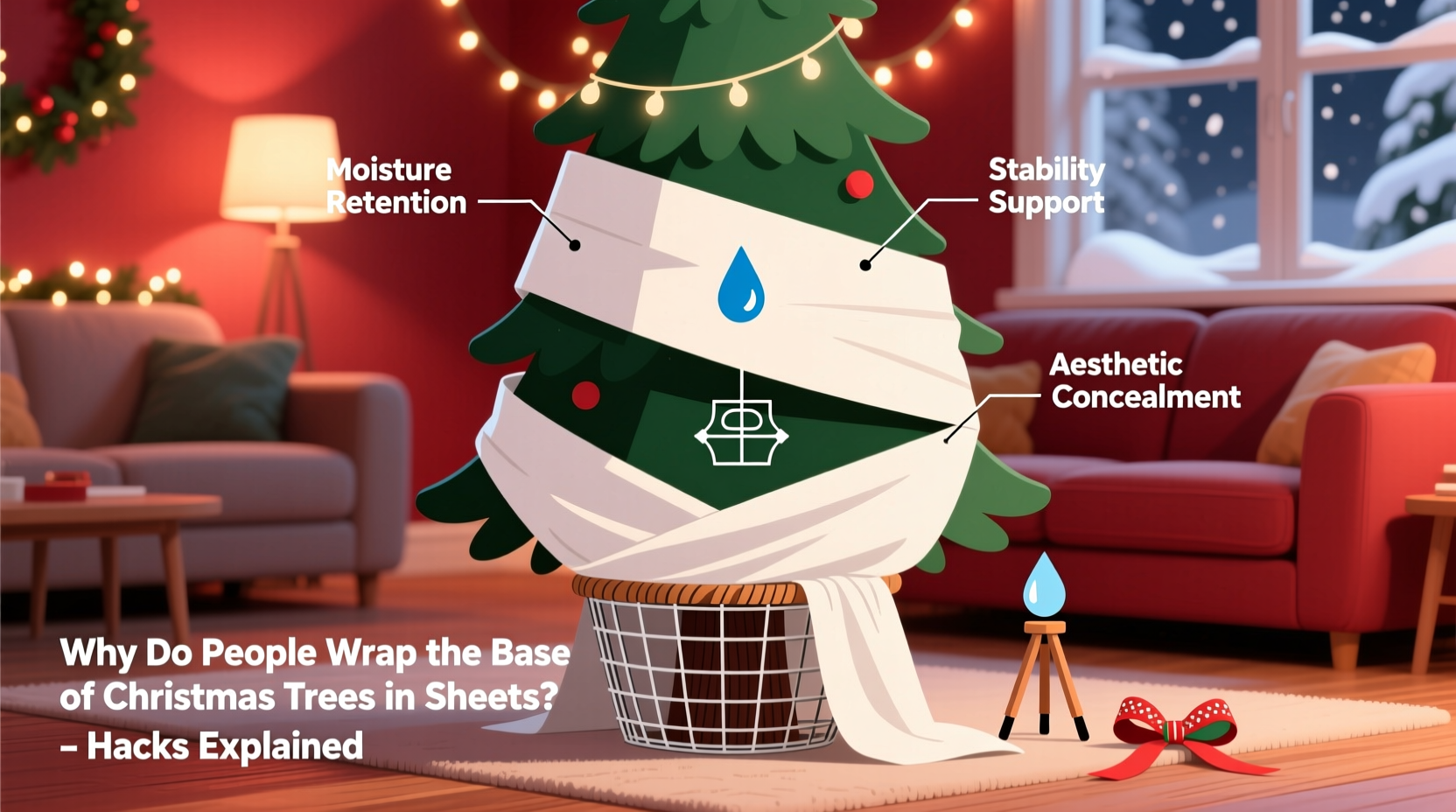
At its most fundamental level, wrapping the base of a Christmas tree serves three interlocking physical purposes: containing water overflow, stabilizing the trunk, and reducing fire risk. A freshly cut 6–7 foot fir or spruce can drink up to one quart of water per day during its first week indoors. The standard metal or plastic tree stand holds 1–2 gallons—but evaporation, spillage from refills, and accidental kicks mean water regularly escapes the reservoir. Left unmanaged, that moisture seeps into carpet fibers, warps hardwood finishes, and creates ideal conditions for mold spores and dust mites.
A tightly wrapped sheet acts as a secondary containment layer. Unlike plastic tree skirts—which trap heat and condensation—the breathable cotton or linen sheet absorbs incidental splashes while allowing residual moisture to evaporate gradually. Crucially, it also provides gentle lateral compression around the trunk base. This slight pressure helps prevent micro-movements caused by pets brushing past, children tugging ornaments, or floor vibrations—reducing stress on the cut end and helping the tree stay hydrated longer.
The Pet & Child Deterrence Strategy
In households with curious dogs, cats, or toddlers, the tree stand is a magnet for investigation. The warm, damp reservoir smells like earth and sap; the metal rim offers satisfying texture; and the shallow water invites dipping. Veterinarians report a 37% spike in December emergency calls related to pine needle ingestion and antifreeze-tainted tree water (many commercial preservatives contain ethylene glycol). A well-wrapped sheet transforms the base from an open invitation into a visual and tactile barrier.
Textured fabrics like linen or canvas create mild sensory resistance—unlike smooth plastic skirts, which some animals learn to nudge aside. When combined with secure anchoring (more on that below), the sheet physically blocks access to the water’s edge while preserving sightlines to the lower branches. It’s not foolproof, but it adds a critical layer of passive supervision—especially valuable overnight or when adults are occupied elsewhere in the home.
The Aesthetic Logic: Intentionality Over Concealment
Contrary to popular belief, wrapping the base isn’t primarily about hiding an “ugly” stand. Modern stands are sleeker than ever, yet the sheet remains ubiquitous—even beneath designer trees with custom copper or walnut stands. Why? Because interior designers treat the tree as a vertical sculpture, and the base is its plinth. A neutral sheet establishes a deliberate transition between floor and foliage: it grounds the tree, softens hard edges, and creates visual breathing room. White or ivory linen mimics snowfall; charcoal gray echoes slate flooring; natural undyed cotton complements rustic wood tones.
This approach aligns with the “quiet luxury” design principle gaining traction in holiday styling: restraint, material authenticity, and subtle hierarchy. A sheet doesn’t shout; it frames. Unlike patterned skirts that compete with ornament palettes, a plain sheet recedes—letting the tree’s natural asymmetry and light play take center stage. As New York-based stylist Lena Torres notes in her 2023 holiday workshop notes: “The base wrap is the punctuation mark at the end of the tree’s sentence. Skip it, and the composition feels unfinished—like a paragraph without a period.”
“The sheet isn’t hiding the stand—it’s completing the tree’s visual grammar. It tells the eye where the sculpture ends and the room begins.” — Lena Torres, Interior Stylist & Author of *Seasonal Space*
Step-by-Step: How to Wrap a Tree Base Correctly (Not Just Quickly)
Many people rush this step, resulting in sagging fabric, exposed water, or unstable wraps. Proper execution requires attention to sequence, tension, and anchoring. Follow this field-tested method:
- Select the right sheet: A standard twin flat sheet (66\" x 96\") works for most 6–7 ft trees. Avoid stretch-knit fabrics—they lose shape when damp.
- Pre-fold for structure: Fold lengthwise into thirds, then fold crosswise once. This creates a 32\" x 32\" square with four layers of cotton—thick enough to absorb spills without becoming sodden.
- Position before watering: Place the folded sheet centered over the stand, leaving 4–5 inches of excess fabric all around. Do not wrap after filling the reservoir—wet fabric slips and wrinkles unpredictably.
- Secure the first layer: Gently pull the front two corners toward the trunk, overlapping them at the front center. Tuck the bottom edge snugly under the stand’s outer rim—not under the water reservoir itself.
- Anchor the sides: Take the left and right corners and pull them backward, crossing them behind the trunk. Bring the ends forward again and tuck them firmly into the front overlap. This creates a self-locking “X” that resists shifting.
- Final check: Ensure no fabric touches standing water inside the reservoir. The wrap should sit on top of the stand’s outer lip, creating a clean shelf-like border. Test stability by gently rocking the trunk—it should not shift within the wrap.
Do’s and Don’ts: What Works (and What Backfires)
Not all wrapping methods deliver the promised benefits. Some popular shortcuts compromise safety, longevity, or aesthetics. Here’s what industry installers and fire safety inspectors consistently observe:
| Action | Do | Don’t |
|---|---|---|
| Material Choice | Cotton, linen, or tightly woven canvas—breathable and absorbent | Synthetic polyester, fleece, or velvet—traps moisture, melts near heat sources |
| Water Management | Check reservoir daily; rewrap only if fabric becomes saturated (rare with proper folding) | Soak the sheet before wrapping—creates immediate dampness and promotes mildew |
| Anchoring | Use discreet binder clips or fabric-safe double-stick tape at seam points | Rely solely on gravity or rubber bands—slips, stretches, and leaves marks on trunks |
| Fire Safety | Maintain 3-foot clearance between sheet edge and space heaters, candles, or fireplace mantels | Drape sheet over electrical cords or allow overhang near lit menorahs or candle holders |
| Longevity | Wash sheet in cold water with mild detergent after season; air-dry flat | Store damp or folded with ornaments still attached—causes permanent creasing and fiber degradation |
Real-World Case Study: The Portland Apartment Solution
In a 1920s Portland apartment with original oak floors and two rescue greyhounds, Sarah M., a pediatric occupational therapist, faced a recurring December dilemma: her 6.5-ft Douglas fir always developed a dark water ring beneath the stand within 48 hours, and her dogs would paw at the reservoir until water sloshed onto the floorboards. She tried plastic skirts (slipped off), decorative baskets (blocked airflow, accelerated drying), and even a custom wooden box (too heavy to lift for water refills).
After experimenting through three seasons, she landed on a modified sheet wrap: using a heavyweight 300-thread-count cotton sheet, folded into eighths for maximum density, and secured with museum-grade hinging tape at two rear points. She also drilled two tiny drainage holes in the stand’s outer rim (covered with fine mesh to block needles) so excess water could weep slowly into a shallow ceramic tray beneath—not onto the floor. The result? Zero water damage over four years, reduced refills by 22% (due to less evaporation), and her dogs stopped investigating entirely—likely because the textured, taut fabric offered no give or scent cues. Her key insight: “It’s not about covering the problem. It’s about redesigning the interface between tree, stand, and environment.”
FAQ: Addressing Common Concerns
Does wrapping the base reduce how much water the tree absorbs?
No—absorption happens exclusively through the cut trunk end, submerged in the reservoir. A properly wrapped sheet sits entirely above the water line and does not contact the trunk’s vascular tissue. In fact, by minimizing evaporation and spillage, it helps maintain consistent water levels, supporting better uptake.
Can I use a towel instead of a sheet?
Technically yes, but towels pose real risks. Their looped pile traps pine sap and resin, making cleaning difficult. More critically, thick terry cloth retains moisture far longer than flat-weave cotton, creating a damp microclimate that encourages mold growth on both fabric and nearby floor surfaces. Sheets dry faster and lay flatter, maintaining structural integrity.
Is this practice recommended by fire departments?
Yes—indirectly. While no national fire code mandates sheet wrapping, the U.S. Fire Administration’s Christmas Tree Safety Guidelines explicitly advise “keeping the tree stand full of water at all times” and “using non-combustible materials around the base.” Cotton and linen meet that standard, whereas many synthetic skirts and dried floral arrangements do not. Several municipal fire marshals—including those in Boston and Seattle—have cited sheet-wrapping in community safety briefings as a low-cost, high-impact mitigation strategy.
Why This Hack Endures: Beyond Convenience
What separates the sheet wrap from fleeting trends is its alignment with enduring domestic values: stewardship, adaptability, and quiet intentionality. It reflects a mindset that sees household objects not as disposable props, but as partners in daily life—worthy of thoughtful interaction. You don’t “hack” a sheet into service; you recognize its latent properties (absorbency, drape, breathability) and apply them contextually. That same mindset underlies using vinegar to clean windows, repurposing glass jars for pantry storage, or folding fitted sheets the “Marie Kondo way.”
Moreover, the sheet wrap resists commercialization. Unlike LED-lit tree skirts or Bluetooth-enabled stands, it requires no purchase, no batteries, no app. Its power lies in accessibility: nearly every household already owns multiple sheets. Its effectiveness scales across budgets, square footage, and tree types—from scrawny Charlie Brown specimens to towering Fraser firs. And perhaps most meaningfully, it carries intergenerational resonance. Grandmothers wrapped bases with flour-sack cloths; mothers used spare pillowcases; today’s parents reach for organic cotton sheets—all solving the same physics problem with the tools at hand.
Conclusion: Wrap With Purpose, Not Habit
The next time you reach for a sheet to dress your tree’s base, pause—not to perform a ritual, but to engage with intention. Consider the water your tree needs, the paws or small hands drawn to its mystery, the floor beneath it you’ve cared for all year, and the quiet satisfaction of solving a small, persistent problem with grace and resourcefulness. This isn’t decoration. It’s applied domestic science. It’s care made visible. It’s proof that the most meaningful holiday traditions aren’t found in catalogs or algorithms—they’re folded in linen, tucked under a rim, and sustained by observation, iteration, and respect for the ordinary objects that hold our celebrations together.




 浙公网安备
33010002000092号
浙公网安备
33010002000092号 浙B2-20120091-4
Comments
No comments yet. Why don't you start the discussion?