
In the fast-paced world of social media, few things capture attention like a viral trend. Whether it's a dance, a meme, or a 15-second skit, trends can define cultural moments almost overnight. But not all platforms are equal in how quickly these trends gain momentum. TikTok consistently outpaces Instagram when it comes to spreading challenges and viral content — and the reason lies deep within its algorithmic architecture, user experience design, and behavioral psychology.
This isn’t just about popularity; it’s about system design. While both TikTok and Instagram are owned by tech giants with massive reach, TikTok has engineered a machine optimized for discovery and speed. Instagram, despite introducing Reels, still operates under legacy systems that prioritize existing relationships over random virality. Understanding this difference reveals more than just how trends go viral — it shows where the future of digital culture is headed.
The Algorithm Divide: Feed Logic and Content Discovery
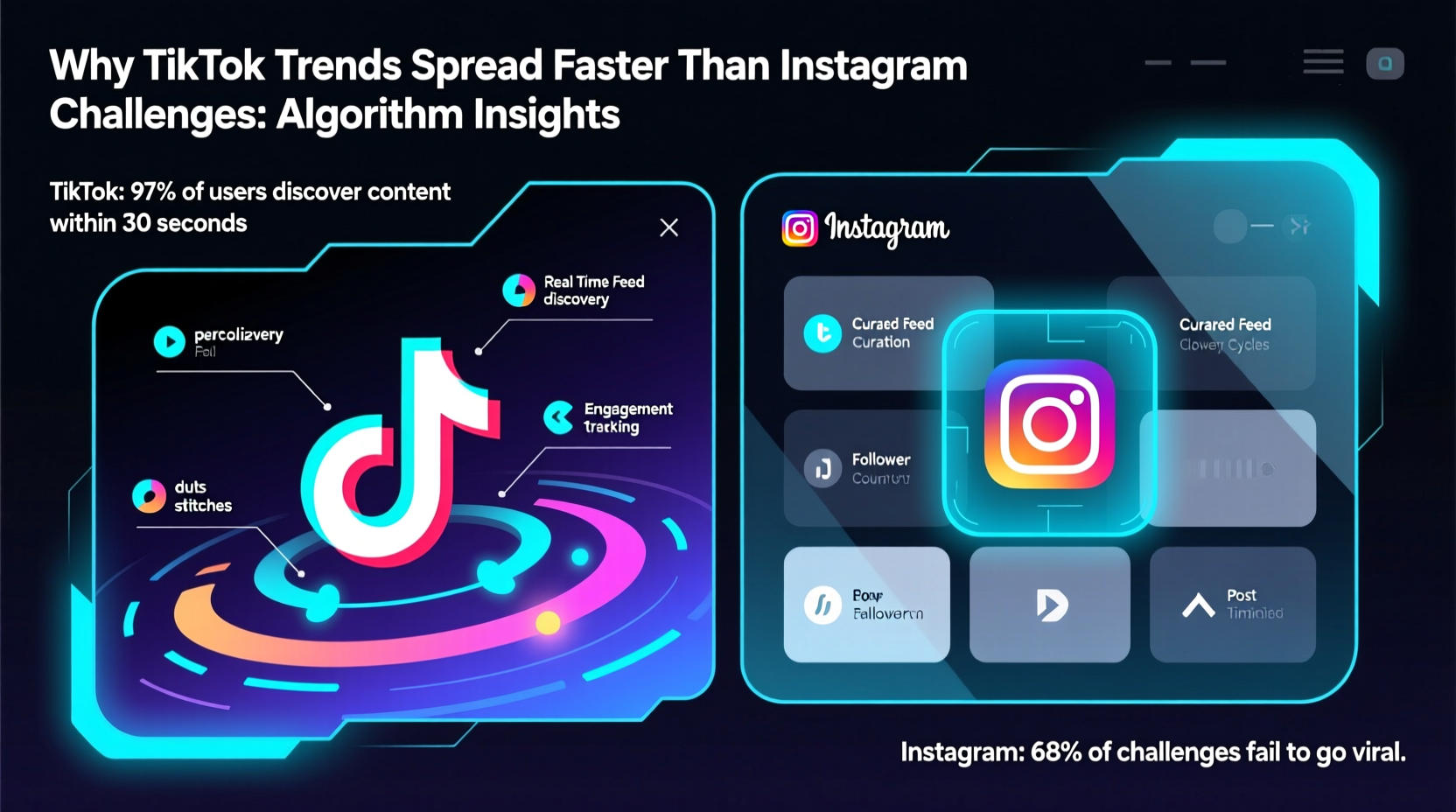
The core reason TikTok trends spread faster than Instagram challenges lies in their respective recommendation algorithms. TikTok’s “For You Page” (FYP) is powered by a highly adaptive machine learning model designed to surface content based on engagement patterns, not follower count. This means even users with zero followers can go viral if their content resonates with early viewers.
Instagram, on the other hand, primarily relies on a social graph-based feed. Even with Reels, the platform prioritizes content from accounts you follow, interact with, or are connected to through mutual activity. This creates an inherent bottleneck for new creators and emerging trends unless they already have an established audience.
“TikTok rewards novelty and immediate engagement. Instagram rewards consistency and network strength.” — Dr. Lena Park, Digital Behavior Researcher at MIT Media Lab
TikTok’s algorithm evaluates multiple signals within seconds of a video being posted: watch time, completion rate, shares, likes, comments, and even rewatches. If a video performs well in the first 60 minutes, it gets pushed to larger audiences in rapid succession. This creates a snowball effect that Instagram’s slower, relationship-driven system struggles to replicate.
User Experience: Frictionless Consumption vs. Curated Scrolling
Beyond algorithms, the user interface plays a critical role in trend velocity. TikTok’s full-screen, vertical scroll format removes distractions. There’s no sidebar, minimal text, and no need to click into profiles to keep watching. Users enter a continuous loop of content consumption, which increases dwell time and exposure to new trends.
Instagram, while adopting a similar Stories and Reels layout, still integrates traditional posts, carousels, ads, and profile navigation into the main feed. This fragmented experience interrupts immersion. A user might see a Reel, then immediately switch to a photo post or DM notification, breaking the flow needed for rapid trend adoption.
Additionally, TikTok encourages mimicry through built-in tools. Duet, Stitch, and remix features allow users to respond directly to videos, often using the same audio clip. This lowers the barrier to participation — all someone needs is a sound and a concept. On Instagram, creating a challenge response requires manually searching for the original, saving the audio, and hoping the algorithm picks up the connection.
Comparison: Trend Participation Mechanics
| Feature | TikTok | |
|---|---|---|
| Audio Accessibility | One-tap use of trending sounds | Must save or search for audio |
| Response Tools | Duet, Stitch, Remix built-in | No direct duet feature |
| Discovery Speed | Minutes to hours | Hours to days |
| Anonymous Virality | Common (zero followers go viral) | Rare (requires network or promotion) |
| Completion Rate Influence | Highly weighted | Moderately weighted |
Psychological Triggers: Why TikTok Feels Addictive
The speed at which TikTok trends spread isn’t just technical — it’s psychological. The platform leverages principles of variable reward scheduling, a concept studied extensively in behavioral psychology. Each swipe delivers unpredictable content: sometimes funny, sometimes emotional, sometimes bizarre. This unpredictability keeps users engaged longer, increasing the likelihood they’ll encounter and participate in a trend.
Moreover, TikTok uses micro-trends — small, easy-to-copy ideas that require minimal effort. Think of the “Oh no” audio, the “Get ready with me” transitions, or the “Tell me without telling me” prompts. These are low-barrier, high-reward formats that invite quick replication. Instagram tends to favor polished, aesthetic content, which raises the perceived effort needed to join a challenge.
TikTok also normalizes imperfection. Grainy footage, unedited clips, and spontaneous reactions are not only accepted but celebrated. This authenticity reduces performance anxiety and encourages broader participation. On Instagram, especially among younger users, there’s still pressure to curate a visually cohesive profile, making impromptu trend participation feel risky.
Mini Case Study: The “Silhouette Challenge” Across Platforms
In late 2021, the “Silhouette Challenge” emerged as a viral sensation. Participants would stand in front of a bright light, wearing dark clothing, to create a revealing outline of their bodies. The trend exploded on TikTok, amassing over 1.3 billion views in less than a week. Videos spread rapidly across demographics, with influencers, teens, and even celebrities joining in.
On Instagram, the same challenge gained traction more slowly. Despite Reels promoting similar content, the trend peaked nearly five days later and was heavily moderated due to nudity policies. Many posts were removed, and the algorithm suppressed visibility. The delay and restrictions limited organic spread, demonstrating how policy enforcement and feed logic can slow trend velocity.
The divergence wasn’t just about content moderation — it reflected deeper structural differences. TikTok’s algorithm amplified the trend before moderation teams could react, while Instagram’s slower rollout allowed for preemptive filtering. In this case, speed favored TikTok; control favored Instagram.
Content Lifespan and Network Effects
Another factor influencing trend speed is content lifespan. On TikTok, a video can remain relevant for weeks due to algorithmic recycling. If a user engages with a type of content, the FYP may resurface older but related videos, giving trends extended legs. Instagram Reels, however, tend to fade quickly — often within 48 hours — unless boosted or shared externally.
TikTok also benefits from stronger network effects. When a trend starts, it doesn’t just spread linearly; it branches. One user inspires ten, who each inspire ten more, creating exponential growth. Because the platform recommends content globally and across niches, a dance trend from Nashville can appear in Jakarta with little delay.
Instagram’s network remains more siloed. Trends often stay within communities — fashion circles, fitness groups, or regional clusters — unless picked up by major influencers. This containment slows diffusion and limits cross-pollination.
Checklist: How to Ride a TikTok Trend Before It Hits Instagram
- Monitor the FYP daily for emerging sounds and hashtags
- Use third-party tools like TrendTok or TokBoard to track rising audios
- Create your version within 6–12 hours of a trend appearing
- Post with high-engagement captions (e.g., “Who else is doing this?”)
- Engage with commenters in the first 30 minutes to boost algorithmic ranking
- Avoid over-editing — raw, authentic clips perform better
- Cross-post to Instagram Reels *after* gaining traction on TikTok
Why Instagram Struggles to Keep Up
Despite owning Facebook, WhatsApp, and now pushing Reels aggressively, Meta has not been able to replicate TikTok’s virality engine. Part of the issue is structural inertia. Instagram was built as a photo-sharing app focused on personal connections. Its algorithm evolved to support that model — prioritizing friends, family, and trusted creators.
When Reels was introduced, it was layered on top of an existing system rather than built from the ground up for discovery. As a result, Reels still competes with static posts, Stories, and ads for attention. TikTok, by contrast, is singular in purpose: short-form video discovery.
Furthermore, Instagram’s monetization model leans heavily on influencer marketing and branded content. This incentivizes polished, ad-friendly videos over spontaneous, grassroots trends. TikTok’s creator fund and revenue-sharing programs, while modest, are structured to reward engagement, not sponsorship.
“It’s not that Instagram can’t go viral — it’s that virality is a side effect, not the goal. On TikTok, virality is the product.” — Amir Chen, Tech Analyst at SignalFire
Frequently Asked Questions
Can Instagram ever catch up to TikTok in trend speed?
Possibly, but it would require rebuilding its recommendation engine from scratch. Current updates suggest Meta is moving in that direction, but legacy infrastructure and user expectations make a full pivot difficult. For now, Instagram will likely remain secondary in trend initiation, though it can amplify trends once they’re established elsewhere.
Do TikTok trends last longer than Instagram challenges?
Generally, yes. Due to algorithmic recycling and global reach, TikTok trends often maintain relevance for 2–4 weeks. Instagram challenges typically peak within 3–7 days and decline rapidly unless sustained by influencer campaigns or media coverage.
Is it better to start a challenge on TikTok or Instagram?
Start on TikTok. Its discovery-first model gives new ideas the best chance to gain organic momentum. Once a trend gains traction, repurpose it on Instagram to reach audiences who prefer that platform. Trying to launch a challenge on Instagram first often requires paid promotion to achieve similar results.
Conclusion: Mastering the Speed of Virality
The gap between TikTok and Instagram in trend propagation isn’t accidental — it’s engineered. TikTok’s algorithm, interface, and culture are all aligned around one objective: rapid, widespread content discovery. Instagram, burdened by legacy systems and a different core mission, cannot match that velocity without fundamental changes.
For creators, marketers, and anyone interested in digital culture, understanding this distinction is crucial. It’s no longer enough to post content — you must post it where it can move fastest. TikTok is the ignition point; Instagram is often just the echo.




 浙公网安备
33010002000092号
浙公网安备
33010002000092号 浙B2-20120091-4
Comments
No comments yet. Why don't you start the discussion?