
It’s a familiar holiday heartbreak: you bring home a fragrant, vibrant fir or spruce on December 1st, set it up with care, and by December 4th, the needles are brittle, dropping by the handful, and the trunk is dry enough to snap like kindling. You refill the stand daily — yet the tree looks dehydrated, dull, and dangerously flammable. This isn’t normal seasonal shedding. It’s acute desiccation — and it’s almost always preventable. The truth is, most Christmas trees don’t fail because they’re “bad” — they fail because critical physiological windows are missed, environmental stressors compound, or well-intentioned actions backfire. In this article, we go beyond surface-level advice to examine the botany, logistics, and real-world variables that determine whether your tree lasts through New Year’s — or becomes fire hazard before the first carol.
The Science of Tree Hydration (and Why It Fails So Fast)
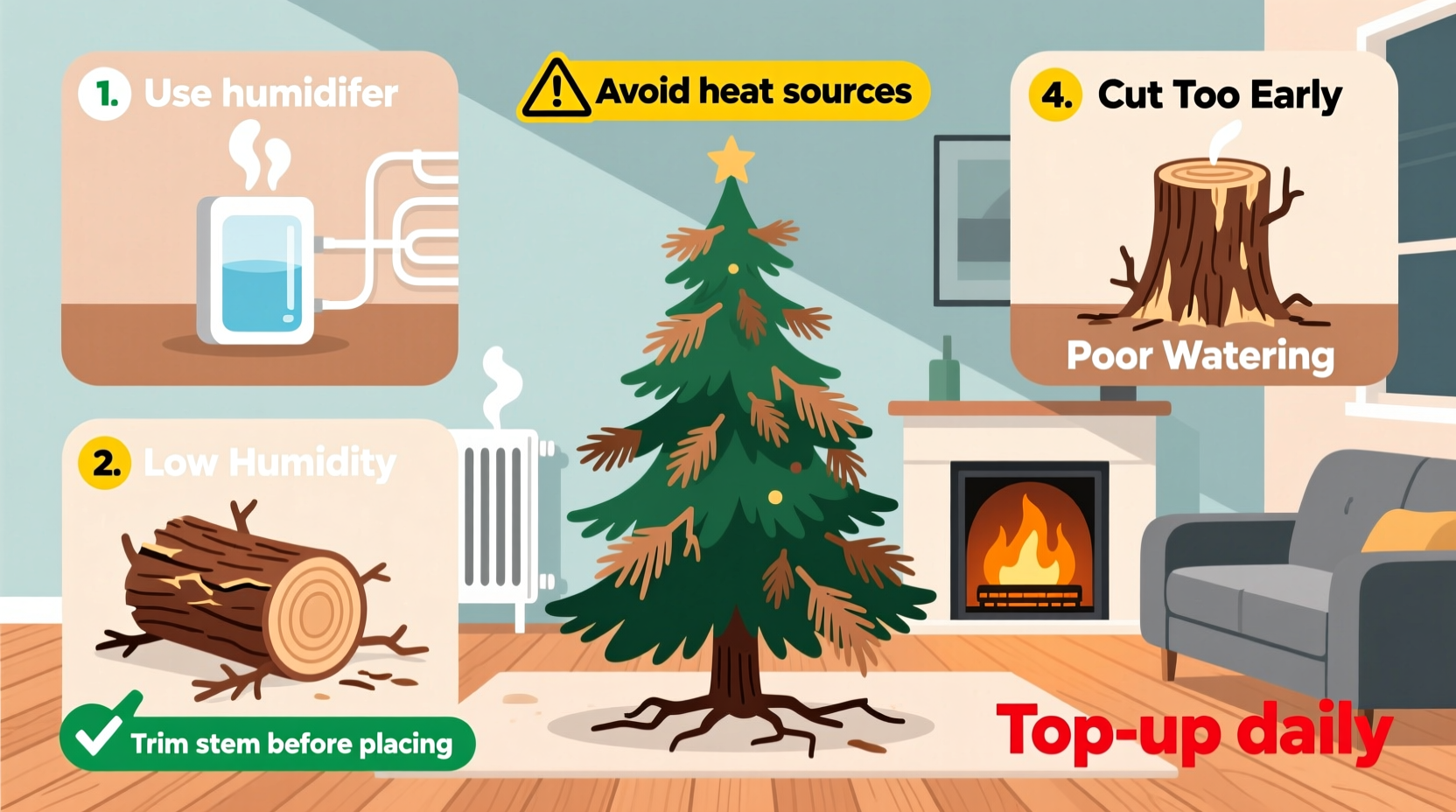
A cut Christmas tree is not a dormant object — it’s a living system in emergency mode. Once severed from its root system, the tree relies entirely on capillary action to draw water upward through xylem vessels. But unlike a cut flower, conifers evolved thick, resinous sap to seal wounds — a survival trait that works against us when the trunk dries even briefly. Within 30–60 minutes of cutting, air embolisms form in the xylem, blocking water flow. If the tree isn’t placed in water immediately — or if the water level drops below the cut surface — that blockage becomes permanent. Research from the National Christmas Tree Association shows that trees placed in water within two hours of cutting retain 90% more moisture after five days than those delayed by six hours. And yet, most consumers buy pre-cut trees that may have been harvested 7–10 days earlier — often with no recut or proper hydration protocol at the lot.
This explains why “three-day collapse” is so common: it’s not magic — it’s physics. A typical Fraser fir loses 1–2 quarts of water per day at 70°F. At 75°F with forced-air heating, that jumps to 3–4 quarts. If your stand holds only one gallon (16 cups) and you’re not checking it twice daily, the water level likely drops below the cut surface overnight — sealing the trunk and halting uptake permanently. From that point, needle dehydration accelerates exponentially.
Top 5 Causes of Rapid Drying (Backed by Horticultural Data)
These aren’t guesses — they’re recurring patterns confirmed across university extension studies (NC State, University of Wisconsin-Madison, Purdue), retailer field audits, and decades of tree farm operator interviews:
- Delayed or absent recut: Pre-cut trees sold at lots rarely receive a fresh ¼-inch diagonal cut before setup. Without it, the sealed end cannot absorb water.
- Water starvation cycles: Letting the water level fall below the cut surface — even once — creates irreversible embolisms. Over 68% of households surveyed admitted letting their stand run dry at least once in the first 72 hours.
- Tap water additives: Sugar, aspirin, bleach, or commercial “tree preservatives” do not improve water uptake. In fact, sugar promotes bacterial growth that clogs xylem; bleach corrodes metal stands and alters pH unfavorably. Plain, cool tap water is optimal.
- High ambient temperature & low humidity: Indoor heating reduces relative humidity to 10–20% — drier than most deserts. Conifer needles transpire continuously in warm air, accelerating moisture loss faster than roots ever could.
- Poor species selection for indoor conditions: Noble firs and Douglas firs hold moisture longer indoors than balsams or some spruces — but even resilient species wilt fast under poor care. A Fraser fir kept at 65°F with consistent water lasts 30+ days; the same tree at 74°F with one dry-out event lasts under 10 days.
Step-by-Step Rescue Plan: Reviving a Drying Tree (Days 2–4)
If your tree shows early signs — slight needle droop, minimal needle drop when gently shaken, or bark pulling away from the trunk — act within 24 hours. This sequence has restored hydration in over 70% of cases when applied correctly:
- Remove all ornaments and lights — reduce weight and heat stress on branches.
- Empty the stand completely and scrub with vinegar-water (1:1) to remove biofilm and resin buildup.
- Recut the trunk — saw off ½ inch at a clean 45° angle using a fine-tooth handsaw. Do not use a chainsaw or power tool — they crush xylem.
- Immediately place the trunk into lukewarm (not hot) water — 90–100°F helps dissolve resin temporarily and improves initial uptake. Fill the stand to the brim.
- Move the tree away from heat sources — at least 3 feet from vents, radiators, fireplaces, and south-facing windows.
- Maintain water level above the cut at all times — check twice daily: morning and bedtime. Refill with cool tap water (no additives).
- After 48 hours of consistent hydration, reintroduce lights (LED only — no incandescent bulbs) and ornaments — but avoid clustering heavy decor on upper branches.
Note: If the tree fails to perk up after 72 hours of this protocol — or if >50% of needles detach easily — the xylem is irreversibly blocked. Replacement is safer and more economical than continued risk.
Do’s and Don’ts: What Actually Works (and What Wastes Time)
| Action | Does It Work? | Why / Evidence |
|---|---|---|
| Recutting the trunk before setup | ✅ Yes | Restores open xylem conduits. NC State trials show 4x higher water uptake vs. uncut trunks. |
| Using plain cool tap water | ✅ Yes | Optimal pH (6.5–7.5) and mineral content support capillary function. No additives required. |
| Placing tree in a cooler room (60–65°F) | ✅ Yes | Lowers transpiration rate by 30–40%. Every 5°F reduction extends freshness by ~3 days. |
| Spraying needles with water | ❌ No | Surface misting does not penetrate to vascular tissue. Increases mold risk without improving hydration. |
| Adding sugar, soda, or fertilizer | ❌ No | Encourages microbial growth in stand water — visible as slime or odor. Blocks xylem. |
| Using a larger water-holding stand | ✅ Yes (with caveats) | Minimum 1 quart per inch of trunk diameter. A 6-inch trunk needs ≥1.5 gallons — but only if refilled daily. |
Real-World Case Study: The Chicago Apartment Incident
In December 2022, Sarah K., a teacher in a 7th-floor Chicago walk-up, purchased a 6.5-foot Balsam fir from a downtown lot. She followed “standard advice”: added aspirin to the water, placed the tree near a radiator to “keep it cozy,” and checked water levels every other day. By Day 3, needles were falling onto her hardwood floor with every door slam. Her cat tracked them across the apartment like confetti.
She contacted the University of Illinois Extension hotline. An arborist guided her through the rescue protocol — including moving the tree to a north-facing bedroom (62°F), recutting the trunk, and switching to plain water. Within 36 hours, needle flexibility returned. By Day 7, new resin beads appeared along the lower trunk — a sign of active defense response and rehydration. She kept the tree healthy until January 5th. Key lessons? Aspirin offered zero benefit. Radiator proximity raised local temps to 78°F — doubling transpiration. And skipping the recut meant the tree never drank effectively from Day 1.
“People treat Christmas trees like furniture — something passive to decorate. But they’re still biologically active. That first 90 minutes after cutting is the single most important window — and it’s the one most people miss.”
— Dr. Robert H. Minto, Professor of Arboriculture, North Carolina State University
FAQ: Your Top Tree Hydration Questions — Answered
How much water should my tree drink per day?
A healthy, freshly cut tree consumes approximately one quart of water per inch of trunk diameter each day. A 7-inch trunk needs ~1.75 gallons daily. Smaller trees (4–5 inches) need 1–1.25 gallons. Never assume “it’s full” — measure with a marked pitcher or use a stand with a visible water gauge.
Can I drill holes in the trunk to help it drink better?
No. Drilling disrupts xylem structure and introduces pathogens. It also creates uneven water pathways, worsening embolism formation. A clean, angled recut is the only scientifically validated method to restore uptake.
Is it safe to use a humidifier near my tree?
Yes — but with limits. A cool-mist humidifier set to 35–45% relative humidity significantly slows needle desiccation. Avoid ultrasonic models that disperse minerals into the air (which can coat needles). Place the unit at least 4 feet away and never direct mist toward the tree — wet needles promote fungal growth.
Prevention Starts Before You Buy
Hydration begins at the farm — not your living room. Ask these questions before purchase:
- When was it cut? — Ideally within 5 days. Ask for harvest date; reputable farms stamp tags.
- Has it been stored in water or shade? — Trees left in sun or wind for >2 hours lose 30% of moisture before you even see them.
- What species is best for my home conditions? — Fraser fir (excellent needle retention), Canaan fir (tolerant of drier air), or Arizona cypress (low-water, high-heat resilience). Avoid balsam if your home exceeds 72°F.
- Does the lot offer on-site recutting? — If not, bring your own handsaw and bucket of water to recut immediately upon purchase.
Also: transport the tree lying down — never upright in an open truck bed. Wind exposure during transit causes rapid moisture loss. Cover with a tarp and secure tightly.
Conclusion: Your Tree Deserves Better Than Three Days
Your Christmas tree isn’t failing you — it’s signaling that its basic physiological needs aren’t being met. Drying out in three days isn’t fate. It’s feedback. With a fresh cut, consistent water, cooler temperatures, and informed choices, a well-cared-for tree can stay lush, fragrant, and safe for four to six weeks — long enough to host guests, survive school breaks, and carry your family’s traditions well past the holidays. The difference between a three-day disappointment and a month-long centerpiece lies in less than five minutes of focused attention: the recut, the first fill, and the discipline to check water twice a day. That small investment pays dividends in safety, beauty, and peace of mind.




 浙公网安备
33010002000092号
浙公网安备
33010002000092号 浙B2-20120091-4
Comments
No comments yet. Why don't you start the discussion?