
Choosing the right backpack isn’t just about style or brand—it’s a functional decision that can impact your posture, comfort, and productivity throughout the semester. For college students, the ideal backpack must balance capacity, ergonomics, and durability while aligning with academic demands. A biology major hauling lab manuals and a laptop will have different needs than a philosophy student carrying only a notebook and water bottle. Understanding how your major influences what you carry—and how much—can help you avoid back strain, overpacking, and unnecessary bulk.
The wrong backpack can lead to chronic shoulder pain, poor spinal alignment, and even reduced focus due to physical discomfort. Yet many students default to oversized urban-style packs or undersized fashion bags without considering their actual daily load. The key is matching backpack volume (measured in liters) to your course load, required materials, and mobility habits across campus.
Understanding Backpack Sizes and Capacity
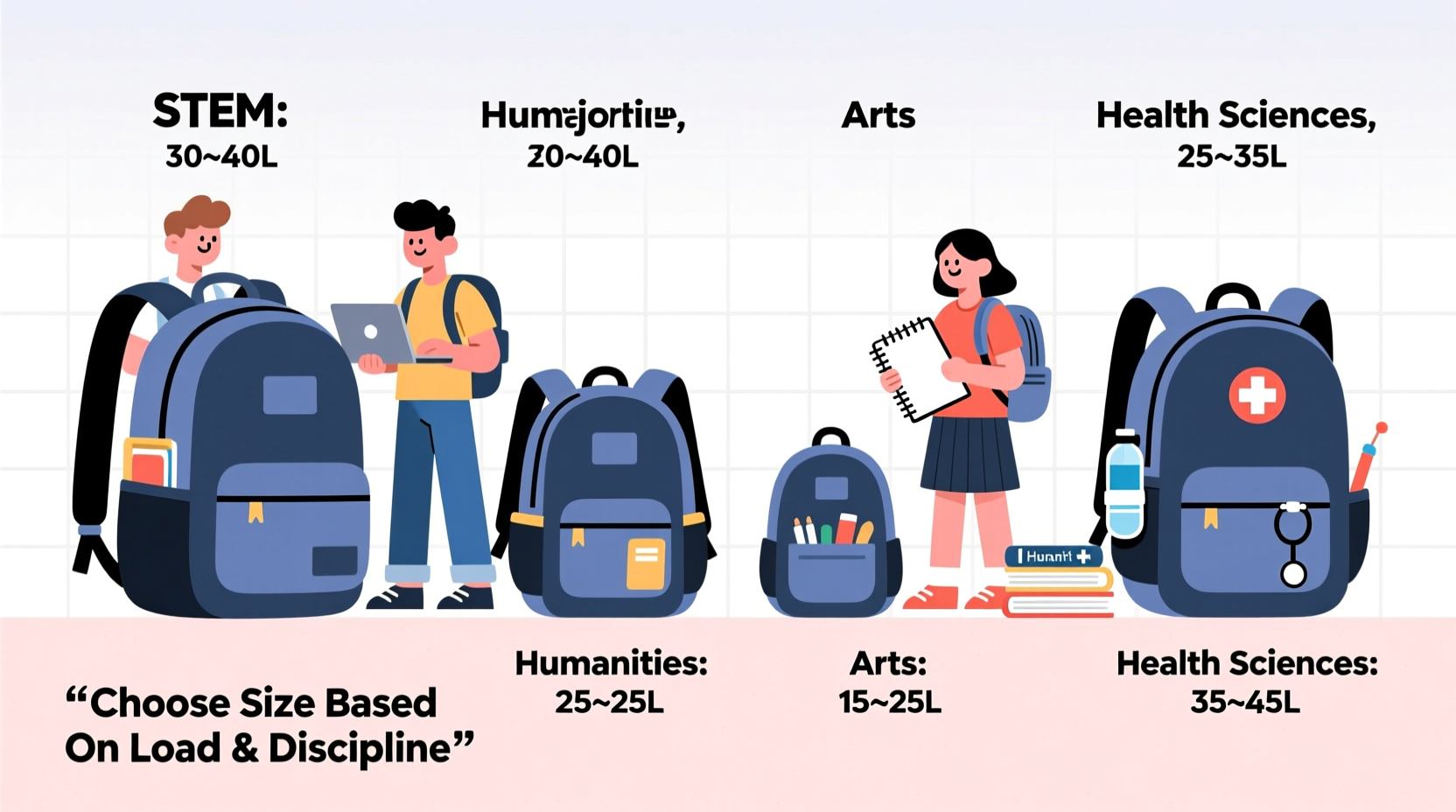
Backpacks are typically categorized by volume: small (10–20L), medium (20–30L), large (30–40L), and extra-large (40L+). Each range serves distinct purposes, and choosing within this spectrum should reflect not just how much you carry, but also how you move through your day.
- 10–20L: Ideal for minimalists or students with light loads. Fits a slim laptop, notebook, phone, and small essentials. Best for short commutes or single-class days.
- 20–30L: The sweet spot for most undergraduates. Offers room for a 15-inch laptop, textbooks, binders, lunch, and personal items without excessive weight.
- 30–40L: Designed for heavy carriers—engineering, pre-med, or art students who transport multiple books, supplies, or equipment daily.
- 40L+: Typically used for travel or outdoor activities. Overkill for most college use unless you're commuting from off-campus housing with gym gear and overnight items.
Volume alone doesn't tell the full story. Internal organization, padding, and access points matter just as much. A well-organized 25L pack may hold more efficiently than a disordered 35L model.
How Your Major Influences Backpack Needs
Your academic discipline directly impacts what—and how much—you carry. Textbook weight varies significantly between majors. According to the College Board, STEM and health science students spend an average of $180 per semester on books, often involving dense, hardcover volumes. In contrast, humanities majors may rely more on digital resources or lighter paperbacks.
Consider these common scenarios:
- STEM & Engineering: Regularly carry heavy textbooks, graphing calculators, lab notebooks, laptops, and sometimes project materials. These students benefit from reinforced stitching, padded laptop sleeves, and external attachment points.
- Pre-Med & Nursing: Transport anatomy atlases, medical dictionaries, stethoscopes, and tablets. Waterproof compartments and quick-access pockets are valuable.
- Art & Design: May need space for sketchbooks, drawing tools, tablets, or cameras. Look for customizable interiors and protective padding.
- Humanities & Social Sciences: Often carry fewer physical books, relying on e-readers or PDFs. A compact, organized pack with good tech storage suffices.
- Business & Communications: Prioritize professional appearance, laptop protection, and meeting-ready accessibility. Briefcase-style hybrids work well.
A student studying mechanical engineering might routinely carry three 3-pound textbooks, a 4-pound laptop, and a binder—totaling nearly 14 pounds before adding water, snacks, or a jacket. That demands structural support and balanced weight distribution. Meanwhile, a literature major might carry a single novel, a tablet, and a notebook—under 5 pounds total—making a sleek, minimalist pack more appropriate.
Backpack Size Recommendations by Major
The following table matches academic disciplines with recommended backpack sizes and essential features based on typical daily loads.
| Major Category | Recommended Size (L) | Key Features | Example Load |
|---|---|---|---|
| Engineering | 28–35L | Padded laptop sleeve, sternum strap, durable fabric, side water bottle pocket | Laptop, 3 textbooks, calculator, notebook, lunch |
| Pre-Med / Biology | 30–35L | Water-resistant lining, ventilated pockets, RFID-safe compartment | Medical atlas, lab coat, stethoscope, tablet, water bottle |
| Art & Design | 25–32L | Expandable main compartment, soft-lined tech sleeve, tripod mount | Sketchpad, iPad Pro, pencil case, camera, headphones |
| Humanities | 18–25L | Slim profile, USB charging port, quick-access front pocket | E-reader, notebook, pen, wallet, keys |
| Business | 20–28L | Professional aesthetic, file divider, anti-theft zippers | Laptop, presentation binder, business cards, resume folder |
Note that some students take hybrid courses or double-major, requiring flexible solutions. An expandable zipper or modular add-ons can bridge gaps between semesters or changing class schedules.
Step-by-Step Guide to Choosing Your Ideal Backpack
Selecting the right backpack involves more than walking into a store and picking the trendiest option. Follow this five-step process to ensure long-term comfort and functionality.
- Inventory Your Daily Load: For one week, record everything you carry to class. Weigh the total at day’s end. Include seasonal variations (e.g., winter jackets, umbrellas).
- Map Your Campus Routine: Consider walking distance between classes, availability of lockers, and whether you eat on campus. Long walks favor ergonomic support; locker access allows smaller packs.
- Determine Required Volume: Based on your inventory, match your load to the size ranges above. Add 5L of buffer for growth or unexpected items.
- Test Ergonomic Fit: Visit a retailer or order from a site with free returns. Wear the pack with weight inside. Shoulder straps should rest comfortably, hip belt (if present) should transfer load, and back panel should contour to your spine.
- Evaluate Organization: Ensure dedicated spaces for tech, writing tools, and quick-grab items. Avoid designs that encourage haphazard stuffing.
This method prevents impulse buys and ensures your backpack supports—not hinders—your academic journey.
Real Student Example: From Pain to Performance
Jessica, a sophomore biochemistry major at the University of Michigan, started her fall semester with a 42L hiking backpack she’d used in high school. “I thought bigger was better,” she said. “But after two weeks, I had constant lower back pain and my shoulders were sore by noon.”
Her daily load included a 15-inch laptop, two heavy textbooks, a lab manual, safety goggles, and a reusable water bottle—totaling 16 pounds. The oversized pack lacked proper lumbar support, and its loose fit caused shifting during her 10-minute walks between labs.
After visiting the campus wellness center, she was referred to a physical therapist who advised switching to a 32L backpack with an S-curve back panel and load-lifter straps. She chose a model with a ventilated back mesh and a removable hip belt. Within a week, her discomfort decreased significantly. “It’s not just about size,” she noted. “It’s about how the weight is carried.”
“Students often underestimate the cumulative effect of carrying heavy loads daily. A properly fitted backpack can prevent long-term musculoskeletal issues.” — Dr. Alan Zhou, Physical Therapist, University Health Services
Common Mistakes and How to Avoid Them
Even informed students make errors when selecting backpacks. Awareness of these pitfalls improves decision-making.
- Mistake: Prioritizing Style Over Support
Fashion-forward packs often lack structured padding or weight-distribution features. While they may look great in photos, they compromise spinal health over time. - Mistake: Using One Strap Only
This creates uneven pressure, leading to muscle imbalances. Always use both straps, and adjust them so the pack sits snugly between shoulders and waist. - Mistake: Overloading Compartments
Just because a pack has space doesn’t mean you should fill it. Carry only what’s needed for the day. Rotate books stored in dorm rooms or digital backups. - Mistake: Ignoring Weather Resistance
Rain or snow can ruin electronics and papers. Choose packs with water-resistant coatings or include a lightweight rain cover.
Checklist: Final Backpack Selection Criteria
Before purchasing, confirm your backpack meets these essential standards:
- ✅ Volume matches your typical academic load (within 20–35L for most students)
- ✅ Padded, adjustable shoulder straps with optional sternum or hip stabilization
- ✅ Dedicated, cushioned laptop compartment (fits your device size)
- ✅ Multiple internal pockets for organization (pen slots, phone pouch, etc.)
- ✅ Durable material (e.g., ballistic nylon, recycled polyester) with reinforced stitching
- ✅ Side or bottom access for water bottles or quick-grab items
- ✅ Reflective details or bright colors for visibility during early/late commutes
- ✅ Weight under 3 pounds when empty (to minimize base load)
Frequently Asked Questions
Can I use a rolling backpack for college?
Rolling backpacks reduce shoulder strain but are impractical on crowded campuses with stairs, escalators, or uneven sidewalks. They’re best suited for students with mobility challenges or those living far from classrooms. If chosen, opt for a hybrid model with retractable wheels and wearable straps.
Is a 20L backpack enough for a full course load?
It depends on your major. A 20L pack works well for humanities or social sciences students with digital textbooks and minimal gear. However, STEM or pre-professional majors will likely exceed capacity. Evaluate your actual load before deciding.
How do I know if my backpack fits correctly?
A properly fitted backpack rests 2 inches below the shoulders and no lower than waist level. The majority of weight should transfer to your hips if a belt is present. There should be no gap between the pack and your back, and you should be able to move freely without adjusting straps constantly.
Conclusion: Invest in Comfort, Not Just Capacity
Your backpack is more than an accessory—it’s a daily tool that affects your physical well-being and academic efficiency. Choosing the right size based on your major and load isn’t about maximizing space, but optimizing function. Whether you're sketching diagrams in studio art or analyzing data in statistics, your pack should support your goals without weighing you down.
Take the time to assess your real-world needs, test fit options, and prioritize ergonomic design. A thoughtful choice today can prevent discomfort tomorrow and set a foundation for healthier study habits. Don’t settle for what looks good—choose what works best for your unique college journey.




 浙公网安备
33010002000092号
浙公网安备
33010002000092号 浙B2-20120091-4
Comments
No comments yet. Why don't you start the discussion?