
It’s a familiar post-holiday scene: decorations are packed away, lights unplugged, and the once-majestic Christmas tree hauled to the curb. But one thing remains—a quiet, curious presence perched precisely where the tree once stood. Your cat, motionless, gazing out from the vacant tree stand as if guarding a sacred relic. You’re not imagining things. This behavior is more common than you might think, and behind it lies a fascinating blend of instinct, routine, and feline psychology.
Cats don’t act without reason. While they may seem aloof or whimsical, their behaviors are deeply rooted in sensory perception, territorial instincts, and environmental memory. The empty Christmas tree stand—often circular, slightly elevated, and embedded with lingering scents—becomes an unexpected focal point in your home long after the holiday season ends. Understanding why your cat chooses this spot offers insight into how cats perceive change, process novelty, and maintain control over their domain.
The Scent Memory Factor
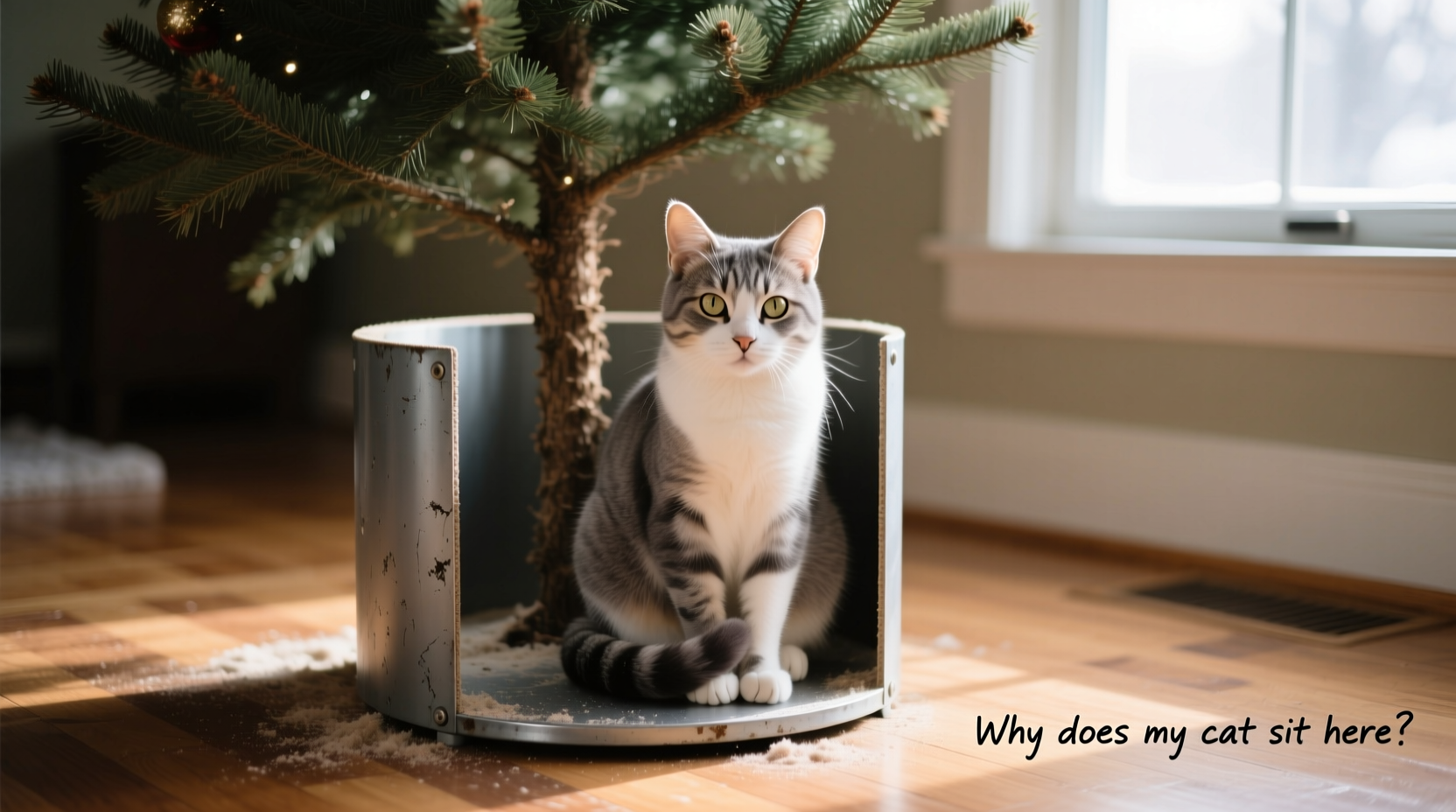
Cats have an olfactory sense that’s up to 14 times stronger than humans. They rely heavily on scent to interpret their surroundings, marking territory and identifying safety through pheromones and environmental odors. When a Christmas tree occupies a space for several weeks, it introduces a complex layer of new smells: pine resin, water from the stand, possibly food-related scents from nearby presents, and even human activity concentrated around the area.
Even after the tree is removed, residual odors linger in the stand, carpet fibers, or hardwood beneath. To your cat, this spot isn’t “empty”—it’s rich with information. The metal or plastic base may retain moisture and organic traces, making it a scent hotspot. By sitting there, your cat is effectively “reading” the environment, reacquainting itself with a changed space.
“Cats are scent-driven animals. A location that held novelty and high human activity during the holidays becomes a point of interest long after the event.” — Dr. Lydia Chen, Feline Behavior Specialist, Cornell Feline Health Center
This behavior mirrors how cats investigate suitcases after a trip or sniff doorways after guests leave. The tree stand, though visually barren, still broadcasts a story through smell—one your cat feels compelled to monitor.
Territorial Reclamation and Routine Disruption
The introduction of a Christmas tree is a significant disruption to a cat’s established territory. Furniture is rearranged, new objects appear, and foot traffic increases. For some cats, this triggers stress; for others, curiosity. But all cats notice.
Once the tree is gone, the space returns—but not instantly to its original state. The absence itself creates a void. Cats thrive on predictability. When a dominant feature disappears, they often engage in “re-mapping” behavior, reassessing boundaries and reaffirming ownership. Sitting in the former tree location is a way of reclaiming normalcy.
In multi-cat households, this behavior can also reflect social hierarchy. The first cat to occupy the vacated stand may be asserting dominance over the revised layout, signaling to others that they control access to this newly altered zone.
The Comfort of Structure and Elevation
Beyond scent and territory, the physical properties of the tree stand play a role. Most stands are circular, creating a natural “nesting” shape. Some are slightly raised, offering a vantage point. Even without the tree, these features mimic ideal resting spots: enclosed, stable, and observation-friendly.
Cats prefer locations where they can see without being exposed. The tree stand—often placed in a living room corner or near a window—typically offers unobstructed sightlines. After weeks of navigating around the tree, your cat has already learned the strategic value of this position. Removing the tree doesn’t erase that advantage—it enhances it by improving visibility.
Additionally, if the stand was filled with water, the surrounding floor may have retained slight humidity, altering the temperature of the surface. Some cats are drawn to cooler or damper spots, especially in centrally heated homes during winter. The residual microclimate of the area could make it temporarily more comfortable than surrounding flooring.
Behavioral Continuity and Habit Formation
If your cat regularly interacted with the tree—batting at ornaments, hiding beneath branches, or simply spending time near it—the stand represents the last remnant of a familiar routine. Habits form quickly in cats, particularly when linked to daily human patterns like gift-wrapping, light-turning, or family gatherings.
When those routines vanish abruptly, cats may linger in associated spaces as a form of behavioral continuity. It’s akin to sitting at a favorite café table after your regular meetups end—you’re not expecting the same experience, but the place holds emotional residue.
This attachment isn’t just nostalgic. Studies show that cats form spatial memories tied to positive reinforcement. If the tree area coincided with extra attention, treats, or play, your cat associates the location with reward. The stand becomes a psychological anchor.
Mini Case Study: Luna and the Silver Stand
Luna, a 4-year-old domestic shorthair from Portland, OR, began sleeping in her family’s aluminum Christmas tree stand two days after takedown. Her owners were baffled—she had never shown interest in the tree itself and even avoided it during setup.
Upon closer observation, they noticed Luna only occupied the stand in the evenings, shortly after dinner. Reviewing security footage, they realized that during the holidays, they had placed a decorative basket of citrus-scented ornaments near the tree—ornaments that contained small bells. The sound of movement (from pets or people) caused gentle ringing.
Though the ornaments were stored, the faint metallic echo from the stand’s base remained when pressure was applied. Veterinarian and behavior consultant Dr. Alan Prescott suggested Luna had developed an auditory association: the subtle creak of the stand mimicked the bell sounds she’d come to expect during family downtime. Her return to the spot was an attempt to recreate a comforting sensory loop.
After placing a small wind chime nearby, Luna’s visits decreased significantly—her need for auditory closure had been met elsewhere.
Step-by-Step: How to Gently Redirect Post-Holiday Cat Behavior
If your cat’s fixation on the empty stand becomes obsessive or disrupts household routines, consider a gradual transition plan. The goal isn’t to stop the behavior abruptly, but to support your cat through environmental change.
- Observe frequency and duration: Note when and how long your cat uses the stand. Is it brief curiosity or extended occupation?
- Clean the area thoroughly: Wipe down the stand and surrounding floor with a mild, fragrance-free disinfectant to reduce scent markers.
- Introduce a replacement perch: Place a cat bed, cushion, or low-sided box nearby to offer a similar vantage point with added comfort.
- Add familiar scents: Rub a piece of your worn clothing or a blanket with your cat’s cheek gland scent on the new perch to encourage use.
- Rotate slowly: Over 5–7 days, begin moving the new perch closer to the stand, then gradually replace the stand with the alternative.
- Remove the stand only after disengagement: Wait until your cat consistently uses the new spot before storing or discarding the stand.
Do’s and Don’ts: Managing the Post-Tree Transition
| Do | Don’t |
|---|---|
| Respect your cat’s need to process environmental changes | Assume the behavior is meaningless or silly |
| Clean the area to reduce lingering scents | Use strong-smelling cleaners that may irritate your cat |
| Offer alternative perches with similar sightlines | Block access abruptly or punish the behavior |
| Monitor for signs of stress (hiding, overgrooming) | Ignore prolonged changes in appetite or litter box use |
| Be patient—behavior shifts take time | Expect immediate adaptation after decor removal |
Frequently Asked Questions
Is it safe for my cat to sit in the Christmas tree stand?
Generally, yes—provided the stand is clean, dry, and free of sharp edges or toxic residues. However, avoid leaving water in the stand, as stagnant water can harbor bacteria or mold harmful to cats. If the stand is made of thin metal that bends easily, supervise use to prevent injury.
My cat never went near the tree, so why sit in the stand now?
The absence of interaction during the holiday doesn’t negate later interest. Cats often assess spaces retroactively. The sudden emptiness may draw attention precisely because it contrasts with prior density. Additionally, the lack of visual obstruction (the tree) now makes the location more accessible and appealing.
Could this behavior indicate anxiety?
Occasional sitting is normal. However, if your cat becomes possessive—hissing at others who approach, refusing to leave for hours, or showing signs of stress (excessive meowing, loss of appetite)—it may signal underlying anxiety related to environmental change. In such cases, consult a veterinarian or certified feline behaviorist.
Conclusion: Honoring Your Cat’s Hidden Language
Your cat sitting in the empty Christmas tree stand isn’t quirky nonsense—it’s communication. It’s a quiet declaration of awareness, a method of processing change, and a testament to how deeply cats engage with their world. What seems like an odd habit is, in fact, a sophisticated response to shifts in scent, structure, and routine.
Rather than dismiss it, consider it an invitation to observe more closely. What other subtle cues is your cat sending? How else might your home transitions—seasonal or otherwise—affect their sense of stability?
By responding with patience and understanding, you strengthen trust and create a more harmonious environment. The next time you pack away the ornaments, take a moment to acknowledge the silent sentinel in the stand. They’re not just occupying space—they’re making sense of a world that, to them, is always speaking—even in silence.




 浙公网安备
33010002000092号
浙公网安备
33010002000092号 浙B2-20120091-4
Comments
No comments yet. Why don't you start the discussion?